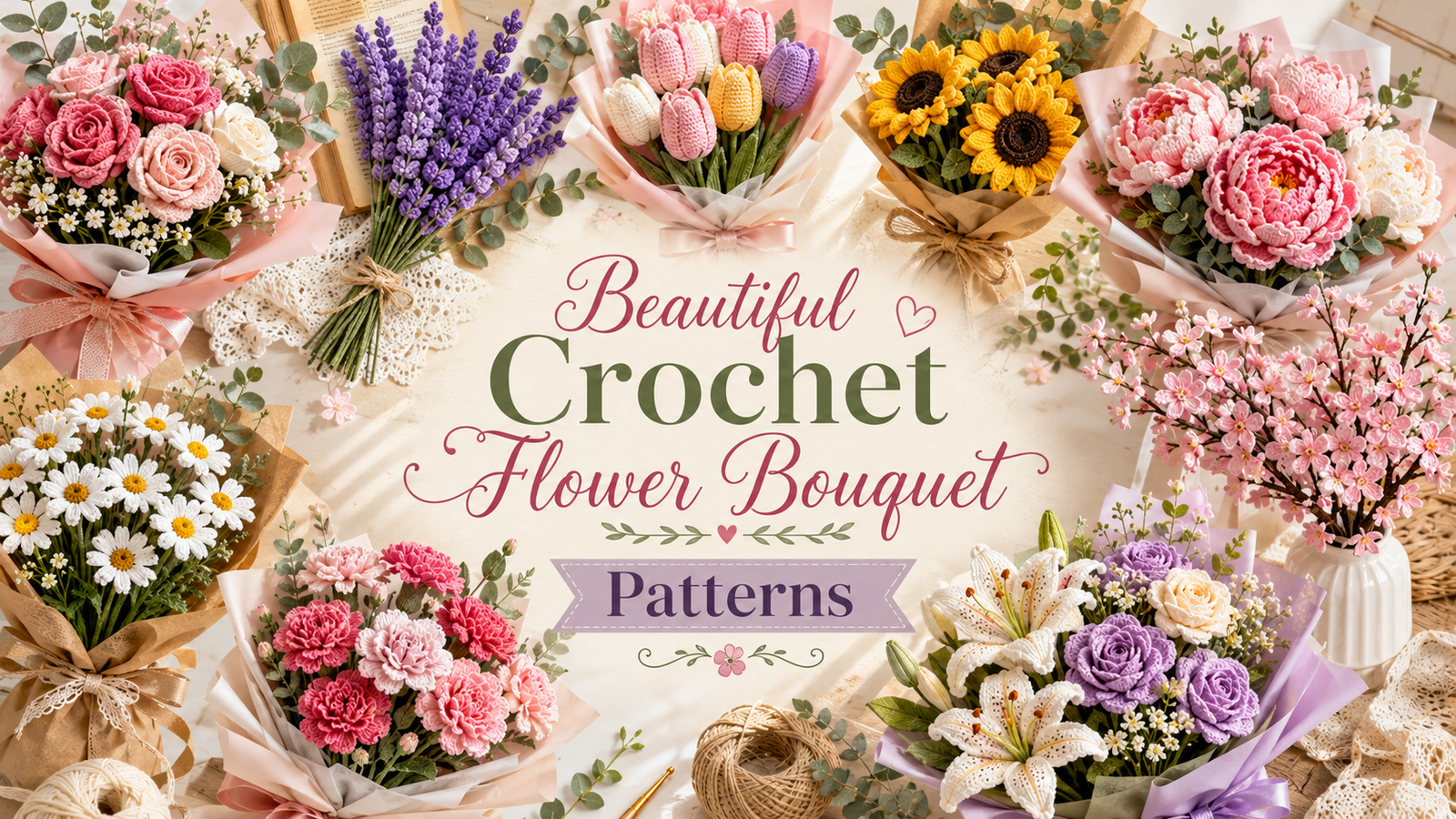
Fresh flowers die in a week. A crochet bouquet lasts a lifetime, and you made it yourself.
Whether you’re crafting a wedding bouquet, a Mother’s Day gift, or a birthday surprise, these free crochet flower bouquet patterns will take you from a ball of yarn to a stunning arrangement step by step. Every pattern below includes skill level, hook size, yarn weight, time estimate, and a link to the free pattern.
Why Crochet Flower Bouquets Are Worth Making
A handmade crochet bouquet offers real advantages over fresh flowers and over store-bought alternatives:
- Lasts for years: without wilting, drooping, or browning
- Fully customizable: choose any color, flower type, or size
- Allergy-friendly: perfect for people sensitive to pollen
- Budget-friendly: a full bouquet costs a fraction of fresh floral arrangements
- Meaningful gift: handmade always lands differently than purchased
- Sellable: Crochet bouquets are popular on Etsy and at craft fairs
Whether you’re a complete beginner working up your first chain stitch or an experienced crocheter looking for a new challenge, there’s a bouquet project here for you.
Best Yarn for Crochet Flowers and Bouquets
Your choice of yarn directly affects how realistic and durable your bouquet looks. Here’s a breakdown of the three main options.
Cotton Yarn, Best Overall
Cotton yarn is the top choice for crochet flowers because it holds its shape exceptionally well. The tight fiber structure creates crisp petal definition that acrylic can’t match. Mercerized cotton (cotton that has been treated for extra sheen and strength) is particularly good for roses, tulips, and lavender stems.
Recommended brands:
- Lion Brand 24/7 Cotton (great stitch definition, wide color range)
- Paintbox Simply DK Cotton (affordable, consistent quality)
- Drops Safran (beautiful for detailed flowers)
Acrylic Yarn, Best for Beginners
Acrylic is widely available, inexpensive, and comes in hundreds of colors, making it an excellent choice when you’re learning or building a large bouquet on a budget. The trade-off is that acrylic flowers tend to be slightly softer and may not hold their shape as firmly over time. Use a hook one size smaller than the label recommends to get tighter, more structured petals.
Recommended brands:
- Red Heart Super Saver (budget-friendly, huge color selection)
- Lion Brand Pound of Love (soft and widely available)
- Caron Simply Soft (great drape for larger flowers)
Cotton-Acrylic Blends, Best of Both
Blended yarns combine the structure of cotton with the softness and affordability of acrylic. If you want a beautiful definition without spending too much, a blend is the smart middle ground.
Recommended brands:
- Lion Brand ComfortBland
- Paintbox Simply DK
Materials Needed for a Crochet Flower Bouquet
Essential Crochet Supplies
| Item | Recommended Size/Type |
| Crochet hooks | 2.5mm, 3mm, 3.5mm, 4mm |
| Cotton or acrylic yarn | DK weight or worsted weight |
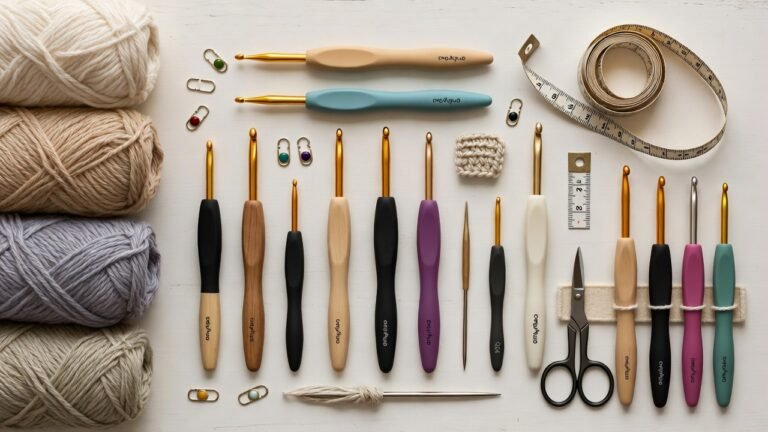
| Yarn needle | Blunt-tip tapestry needle |
| Scissors | Small, sharp embroidery scissors |
| Stitch markers | Locking stitch markers |
Bouquet Assembly Supplies
| Item | Notes |
| Floral wire | 18–22 gauge; thicker = sturdier stems |
| Green floral tape | Self-sealing; wraps wire stems cleanly |
| Wooden skewers | Optional; adds rigidity to tall stems |
| Hot glue gun | For securing flowers to stems |
| Kraft paper or Korean bouquet wrap | For final presentation |
| Satin ribbon or twine | For tying the bouquet handle |
Optional Decorative Additions
- Faux pearl pins
- Lace ribbon
- Dried baby’s breath (for mixed bouquets)
- Small gift tags
- Tissue paper for inner wrapping
How to Make a Crochet Flower Bouquet, Step by Step
Step 1: Choose Your Bouquet Theme
A consistent theme makes your bouquet look intentional rather than random. Decide your theme before crocheting a single flower so your color choices stay coordinated.
Popular themes:
- Romantic Rose Bouquet
- Cottagecore Wildflower Bouquet
- Modern Neutral Bouquet
- Bridal Wedding Bouquet
- Mother’s Day Spring Bouquet
- Graduation Bouquet (school colors)
- Birthday Rainbow Bouquet
Step 2: Crochet Your Flowers
Select one flower type for a focused, elegant arrangement, or mix several varieties for a lush, garden-style bouquet. A well-balanced mixed bouquet typically includes:
- 3–5 focal flowers (your main statement blooms, roses, sunflowers, peonies)
- 3–5 secondary flowers (supporting blooms, daisies, tulips, carnations)
- 3–5 filler flowers (tiny blossoms, baby’s breath, small buds)
- 4–8 greenery pieces (leaves, fern stems, eucalyptus)
Step 3: Create Stems
Sturdy stems are what separate a flat pile of flowers from a real-looking bouquet. There are three main methods:
Method A: Floral Wire + Tape
Push an 18-gauge floral wire through the bottom of the flower, bend a small hook at the top to anchor it, then wrap from top to bottom with green floral tape. Stretch the tape slightly as you wrap; it activates the self-sealing adhesive.
Method B: Wire + Crocheted Tube
Crochet a thin tube in green yarn (chain 4, join, crochet in the round) and thread floral wire through the center. This looks extremely realistic and gives a polished, professional finish.
Method C: Wooden Skewers
Hot glue flowers to the tip of a wooden skewer, then wrap the entire skewer in green floral tape. This is the fastest method and works well for large, heavy flowers.
Step 4: Add Crochet Leaves and Greenery
Greenery is the secret ingredient that makes a good bouquet great. It adds contrast, fills visual gaps, and makes flowers pop. Crochet at least 4–6 leaf pieces per bouquet.
Best leaf types to crochet:
- Simple oval leaves (beginner-friendly)
- Rose leaves with serrated edges
- Eucalyptus sprigs (work up in a chain with small oval leaves)
- Fern fronds (create beautiful texture)
Step 5: Arrange Your Flowers Professionally
Lay all your flowers and greenery on a flat surface before assembling. Hold the bouquet with your non-dominant hand and add stems one at a time with your dominant hand, rotating the bouquet a quarter turn after each addition to ensure it looks balanced from every angle.
Pro florist arrangement rule: Place your largest focal flower slightly off-center at the top, not directly in the center. This creates a more natural, organic look.
Layer order:
- Focal flowers in the upper center
- Secondary flowers are slightly lower and to the sides
- Filler flowers filling gaps
- Greenery positioned so leaves peek out between flowers
Secure the stem bundle with a rubber band, then adjust final positions before wrapping.
Step 6: Wrap the Bouquet
Simple gift wrap:
Cut a large piece of kraft paper into a diagonal square. Place the bouquet face down in the center, fold one corner up over the stems, then fold in the left and right corners. Tie firmly with ribbon.
Korean-style wrap:
Use two sheets of colored tissue or wrapping paper in complementary colors, layered at different angles for a multi-dimensional effect. Tie with a wide satin ribbon.
Fabric wrap:
Wrap stems in a square of hessian (burlap) fabric for a rustic, cottagecore aesthetic. Secure with twine.
How to Arrange Crochet Flowers Like a Professional Florist
The Three-Tier System
Every professional floral arrangement uses this structure. Apply it to crochet bouquets for instant visual polish.
Tier 1: Focal Flowers (Hero Blooms)
These are the eye-catching statement pieces. Use 1–3 varieties maximum. Examples: crochet rose, sunflower, peony, lily.
Tier 2: Secondary Flowers (Supporting Blooms)
These frames complement the focal flowers without competing with them. Examples: daisies, carnations, tulips, and lavender.
Tier 3: Filler + Greenery
These fill visual gaps and add texture. Examples: baby’s breath, tiny blossoms, fern leaves, eucalyptus.
Best Flower Combinations
| Focal Flower | Secondary Flower | Filler | Style |
| Rose | Tulip | Baby’s Breath | Classic Romance |
| Sunflower | Daisy | Lavender | Cheerful & Bright |
| Tulip | Lavender | Tiny Blossoms | Spring Garden |
| Carnation | Daisy | Fern Leaves | Cottage Garden |
| Peony | Rose | Eucalyptus | Luxe Wedding |
| Lily | Lavender | Small Buds | Elegant & Soft |
| Wildflowers | Daisies | Baby’s Breath | Cottagecore |
Bouquet Size Guide
| Size | Flower Count | Best For |
| Posy / Mini | 5–7 flowers | Small gifts, bud vases |
| Small | 8–12 flowers | Birthday gifts, thank-you gifts |
| Medium | 13–18 flowers | Mother’s Day, graduation |
| Large | 19–25 flowers | Wedding bouquets, display pieces |
| Luxury | 25+ flowers | Statement arrangements, showpieces |
Crochet Bouquet Color Palette Ideas
Blush Romance
Soft pink roses + cream daisies + white baby’s breath + blush wrapping paper
Cottagecore Garden
Lavender + soft yellow daisies + pale pink wildflowers + kraft paper wrap
Modern Neutral
Cream flowers + warm beige filler + sage green eucalyptus + white or nude ribbon
Boho Warm
Terracotta roses + mustard yellow daisies + rust-toned dahlias + olive green leaves
Coastal Cool
Soft blue hydrangeas + white roses + seafoam greenery + linen wrap
Classic Wedding White
White roses + white lilies + cream carnations + eucalyptus + white satin ribbon
Spring Pastel
Mint green, soft yellow, baby pink mixed flowers + white filler + pastel ribbon
Free Crochet Flower Bouquet Patterns: How to use this list:
Each pattern entry includes skill level, hook size, yarn weight, approximate time, and what the flower is best used for in a bouquet.
1. Classic 5-Petal Crochet Flower
Skill Level: Beginner | Hook: 3.5mm | Yarn: DK weight cotton | Time: ~15 minutes
The classic 5-petal flower is the most versatile shape in crochet. It works as a filler, a secondary bloom, or stacked in layers to create more complex flowers. Master this one first; everything else builds on it. It uses only chain stitch, slip stitch, and single crochet, making it ideal for absolute beginners.
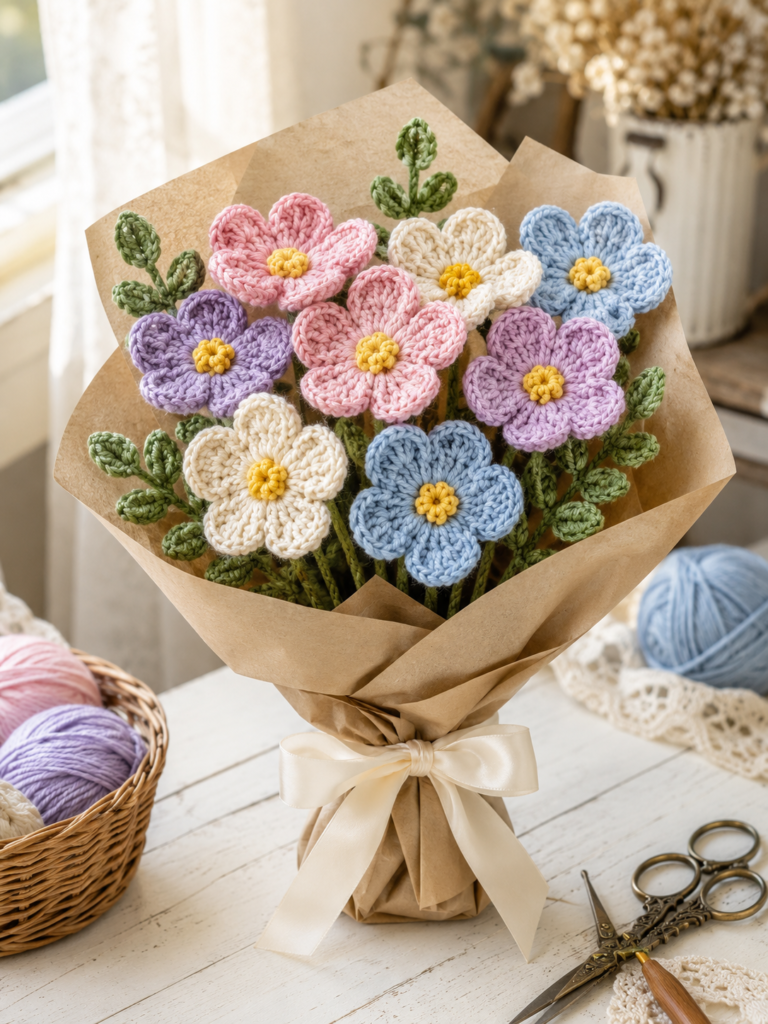
Best For: Fillers, wildflower bouquets, mixed arrangements
Best Yarn
- Mercerized Cotton Yarn
- DK Weight Cotton
- Cotton-Acrylic Blend
Materials
- 3.0mm Crochet Hook
- Cotton Yarn
- Floral Wire
- Green Floral Tape
- Yarn Needle
- Scissors
- Hot Glue (optional)
- Kraft Bouquet Wrap
- Satin Ribbon
Detailed Bouquet Tutorial
Step 1: Crochet 12–15 flowers in coordinating colors.
Step 2: Create yellow flower centers for contrast.
Step 3: Attach floral wire to each flower.
Step 4: Wrap stems with floral tape.
Step 5: Crochet several small leaves.
Step 6: Arrange flowers in a rounded bouquet shape.
Step 7: Place larger blooms in the center.
Step 8: Fill gaps using extra flowers and greenery.
Step 9: Secure stems together.
Step 10: Wrap the bouquet with kraft paper and ribbon.
Arrangement Tips
- Use odd numbers of flowers.
- Mix at least three colors.
- Add greenery between blooms.
- Keep the center slightly higher.
- Rotate the bouquet while arranging.
2. Layered Crochet Rose
Skill Level: Intermediate | Hook: 3mm | Yarn: DK weight cotton | Time: ~35–45 minutes
The layered crochet rose is the most popular focal flower in any bouquet. It’s worked in a continuous spiral with increasing petal height to create the signature rose silhouette. The key to a realistic rose is tight tension; go down one hook size from your yarn’s recommended hook size. Work in mercerized cotton for the best petal definition.
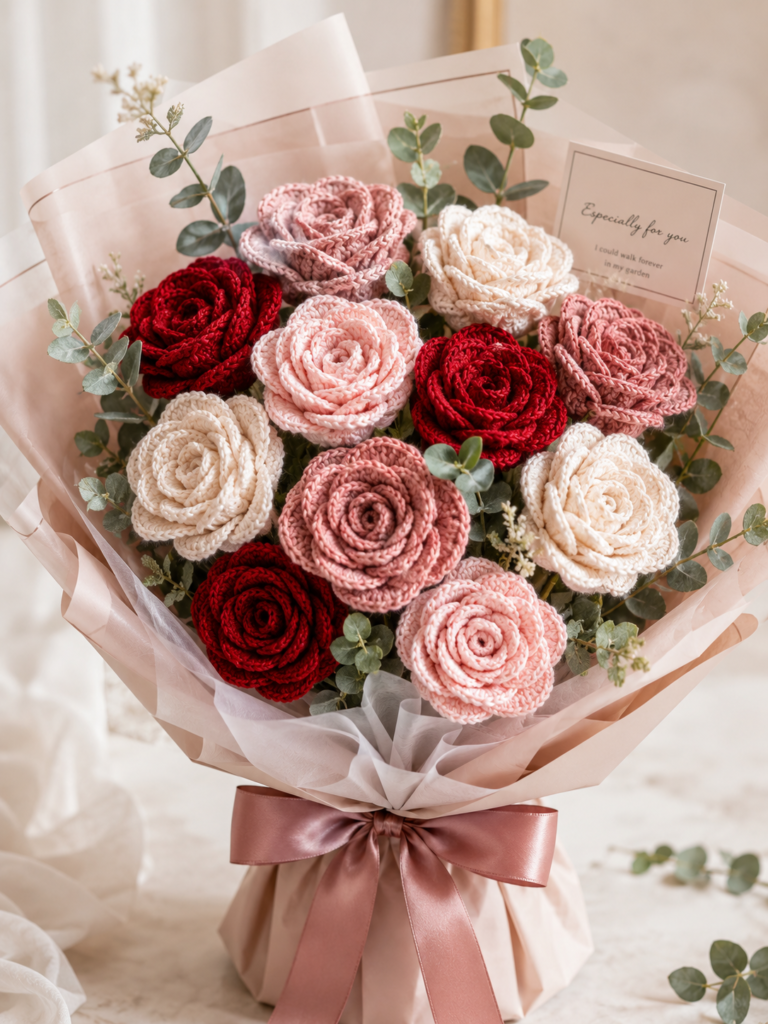
Best For: Focal flowers, wedding bouquets, romantic arrangements
Best Yarn
- Mercerized Cotton
- Fine Cotton Thread
- Cotton Blend Yarn
Materials
- 2.5mm Crochet Hook
- Red, Pink, Cream Yarn
- Floral Wire
- Floral Tape
- Yarn Needle
- Green Yarn for Leaves
- Bouquet Wrapping Paper
- Ribbon
Detailed Bouquet Tutorial
Step 1: Crochet 9–12 layered roses.
Step 2: Shape petals while assembling.
Step 3: Create realistic rose leaves.
Step 4: Attach stems using floral wire.
Step 5: Add eucalyptus-style greenery.
Step 6: Position the largest roses in the center.
Step 7: Arrange smaller roses around them.
Step 8: Insert filler flowers.
Step 9: Secure the bouquet tightly.
Step 10: Wrap with elegant paper and ribbon.
Arrangement Tips
Avoid overcrowding petals.
Use varying rose sizes.
Mix 2–3 rose shades.
Add filler flowers sparingly.
Include plenty of greenery.
3. Crochet Tulip (3D)
Skill Level: Intermediate | Hook: 3mm | Yarn: DK cotton | Time: ~30 minutes
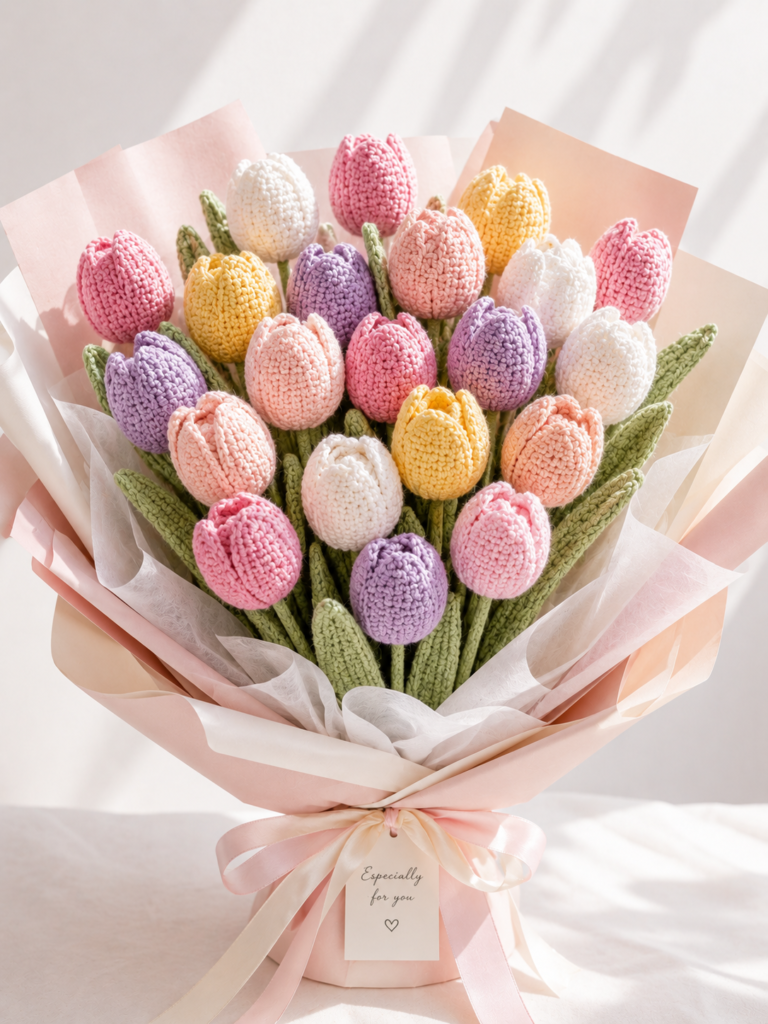
The 3D crochet tulip is worked in the round to create a hollow, cup-shaped bloom that looks remarkably like a real tulip. It’s stuffed lightly with fiberfill or tissue paper to hold its shape. Available in classic single-color versions or two-tone varieties with a contrasting center.
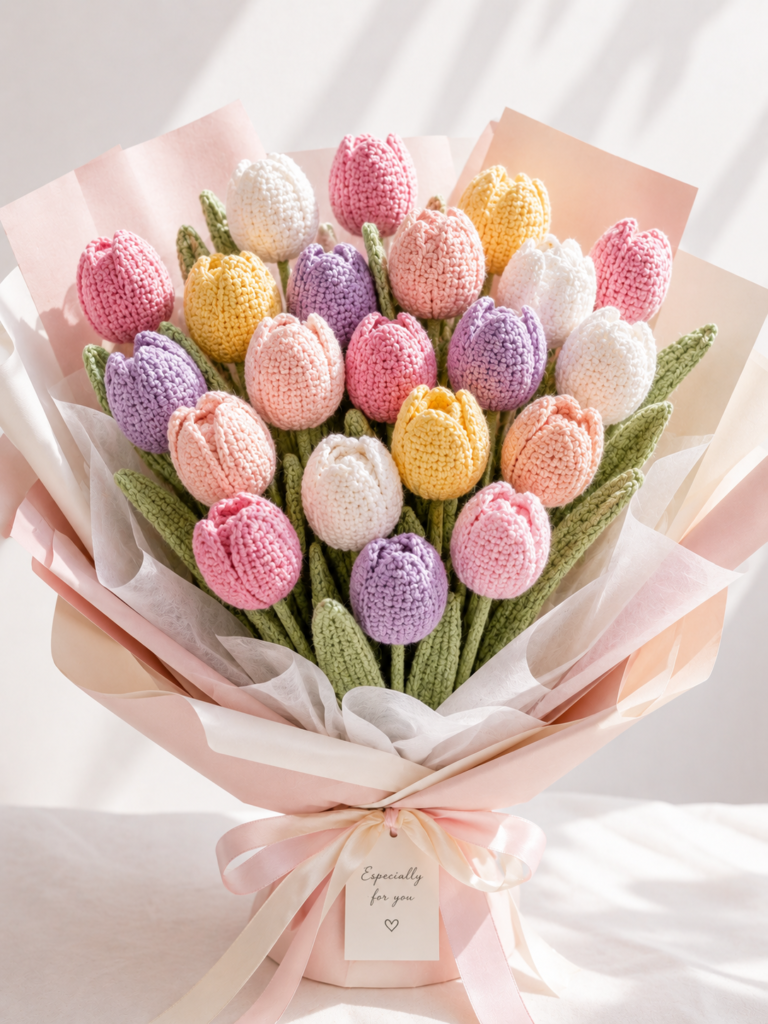
Best For: Spring bouquets, Mother’s Day gifts, statement arrangements.
Best Yarn
- Cotton Yarn
- Mercerized Cotton
- Lightweight Cotton Blend
Materials
- 3mm Crochet Hook
- Cotton Yarn
- Floral Wire
- Floral Tape
- Yarn Needle
- Scissors
- Wrapping Paper
- Ribbon
Detailed Bouquet Tutorial
Step 1: Crochet 10–15 tulip blooms.
Step 2: Create matching tulip leaves.
Step 3: Insert floral wire into stems.
Step 4: Wrap stems with floral tape.
Step 5: Arrange tulips at varying heights.
Step 6: Position the tallest tulips in the center.
Step 7: Add leaves throughout the bouquet.
Step 8: Create a natural, rounded shape.
Step 9: Secure stems together.
Step 10: Wrap with pastel paper.
Arrangement Tips
Add extra leaves for fullness.
Vary flower heights.
Mix spring colors.
Allow tulips to lean naturally.
Avoid perfectly symmetrical layouts.
4. Crochet Sunflower
Skill Level: Beginner–Intermediate | Hook: 4mm | Yarn: Worsted weight acrylic | Time: ~45 minutes
Sunflowers are among the most cheerful additions to any crochet bouquet. The pattern uses a dark brown or black center circle surrounded by two layers of bright yellow petals. Worsted-weight yarn gives sunflowers a nice body and structure. Make several at different sizes for a natural, garden-fresh look.
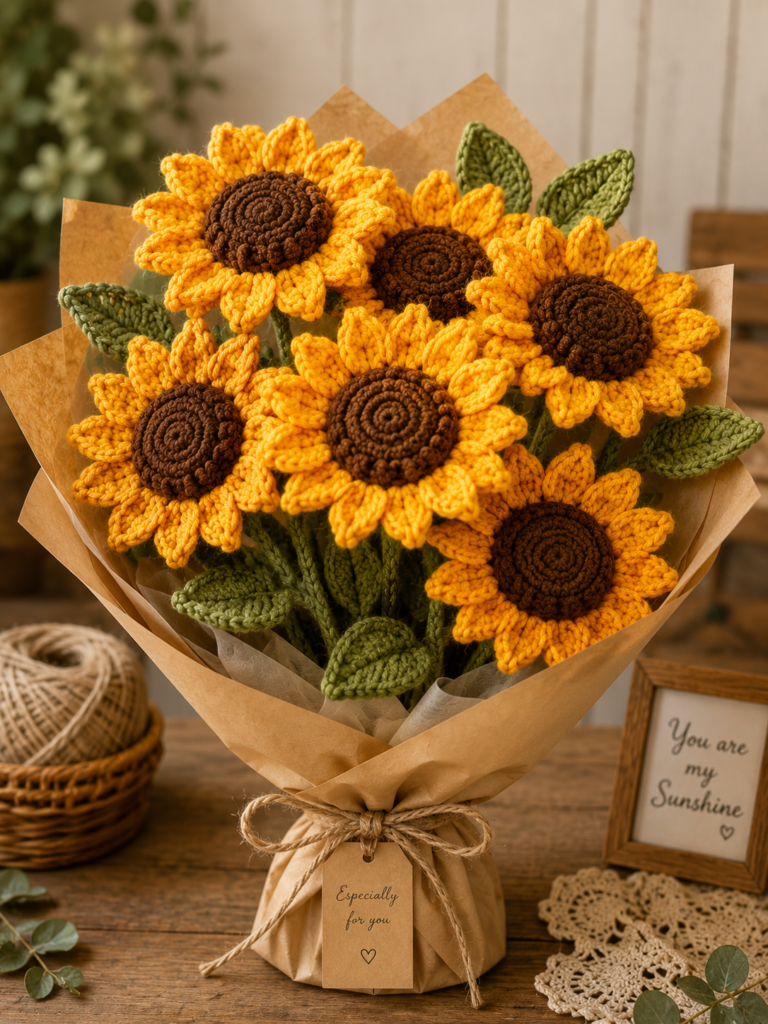
Best For: Summer bouquets, birthday gifts, cheerful arrangements
Best Yarn
- Cotton Yarn
- Cotton Blend
- DK Weight Yarn
Materials
- 3.5mm Crochet Hook
- Yellow Yarn
- Brown Yarn
- Green Yarn
- Floral Wire
- Floral Tape
- Kraft Paper
- Twine
Detailed Bouquet Tutorial
Step 1: Crochet 5–7 large sunflowers.
Step 2: Create textured centers.
Step 3: Make large sunflower leaves.
Step 4: Attach strong wired stems.
Step 5: Arrange flowers in a triangular shape.
Step 6: Place the tallest sunflower in the center.
Step 7: Add greenery around the edges.
Step 8: Balance the bouquet from all sides.
Step 9: Secure stems tightly.
Step 10: Wrap with rustic kraft paper.
Arrangement Tips
Use rustic wrapping.
Use fewer flowers because the blooms are large.
Add extra greenery.
Keep the center flower dominant.
Mix different sunflower sizes.
5. Crochet Daisy
Skill Level: Beginner | Hook: 3.5mm | Yarn: DK cotton | Time: ~20 minutes
Simple and fast to work up, crochet daisies are perfect secondary or filler flowers. The pattern involves a small yellow center circle with long, slim white or pastel petals radiating outward. Make a dozen in an afternoon and scatter them throughout your arrangement for a wildflower meadow effect.
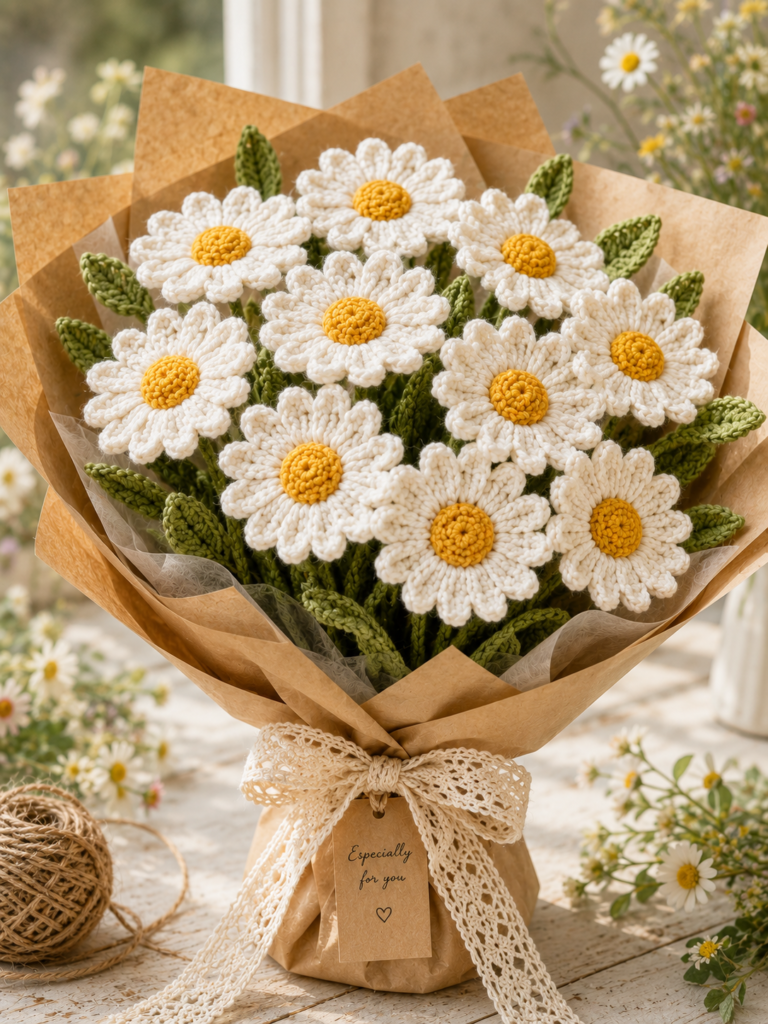
Best For: Fillers, secondary flowers, cottagecore, and wildflower bouquets.
Best Yarn
- Mercerized Cotton
- Cotton Blend
- DK Cotton Yarn
Materials
- 3mm Crochet Hook
- White Yarn
- Yellow Yarn
- Green Yarn
- Floral Wire
- Floral Tape
- Ribbon
- Kraft Paper
Detailed Bouquet Tutorial
Step 1: Crochet 12–18 daisy flowers.
Step 2: Create bright yellow centers.
Step 3: Make several leaf stems.
Step 4: Attach wire stems.
Step 5: Arrange daisies in a dome shape.
Step 6: Insert greenery between flowers.
Step 7: Add small filler blooms.
Step 8: Check bouquet balance.
Step 9: Secure stems.
Step 10: Wrap and finish with ribbon.
Arrangement Tips
- Use lots of flowers for fullness.
- Mix white and cream shades.
- Add lavender stems.
- Include baby’s breath fillers.
- Keep the arrangement loose and airy.
6. Crochet Lavender Stem
Skill Level: Beginner | Hook: 2.5mm | Yarn: Fingering weight cotton, purple | Time: ~20 minutes per stem
Crochet lavender stems add height, elegance, and a soft purple accent that works with almost any bouquet palette. The pattern is simply a chain of small bobble stitches in purple along a green stem. Make 5–7 stems and cluster them together for a realistic lavender effect.
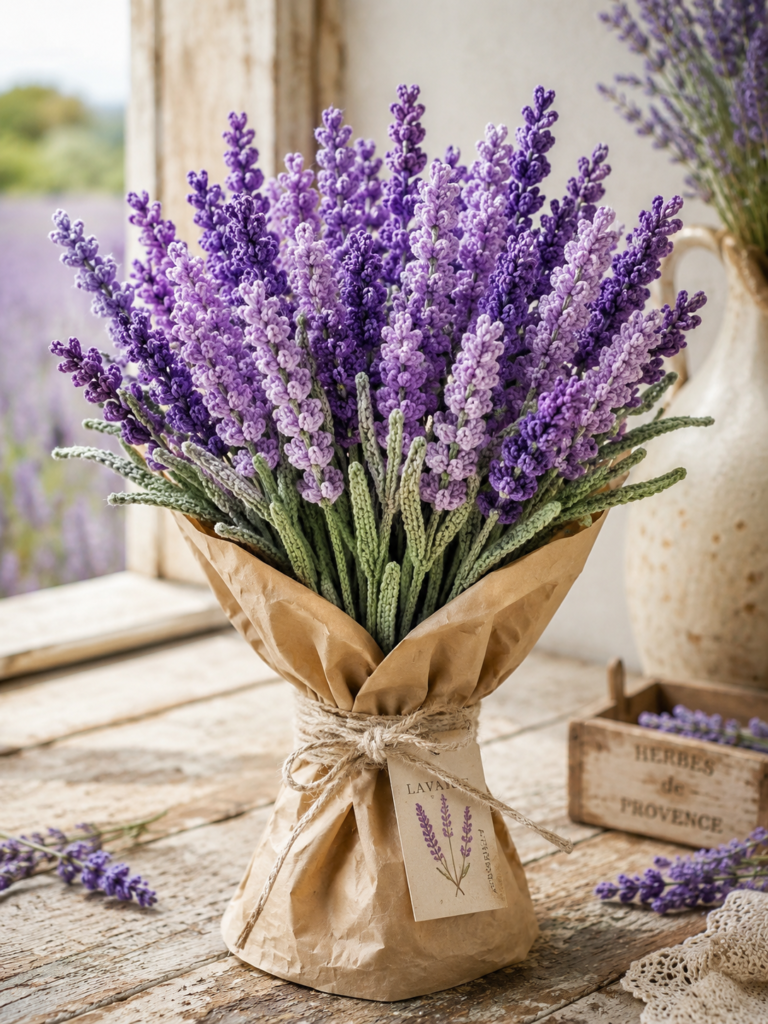
Best For: Fillers, Provence-style bouquets, cottagecore arrangements
Best Yarn
- Mercerized Cotton Yarn
- Sport Weight Cotton
- Cotton Blend Yarn
Materials
- 2.5mm–3mm Crochet Hook
- Purple Yarn
- Green Yarn
- Floral Wire
- Floral Tape
- Yarn Needle
- Scissors
- Kraft Paper
- Twine
Detailed Bouquet Tutorial
Step 1: Crochet 15–25 lavender stems.
Step 2: Create varying stem lengths for a natural look.
Step 3: Insert floral wire into each stem.
Step 4: Wrap stems with green floral tape.
Step 5: Bundle stems loosely together.
Step 6: Add a few leafy stems around the edges.
Step 7: Adjust heights throughout the bouquet.
Step 8: Secure stems near the base.
Step 9: Wrap with kraft paper.
Step 10: Finish with twine or ribbon.
Arrangement Tips
Avoid packing stems too tightly.
Use multiple shades of purple.
Vary stem heights.
Keep the arrangement airy.
Add eucalyptus leaves for contrast.
7. Crochet Peony
Skill Level: Advanced | Hook: 3mm | Yarn: DK cotton, blush or white | Time: ~90 minutes
The crochet peony is the most luxurious focal flower you can make. Multiple tiers of curved, ruffled petals are worked separately and assembled around a dense center. The finished bloom is large, dramatic, and absolutely stunning as the centerpiece of a wedding or anniversary bouquet.
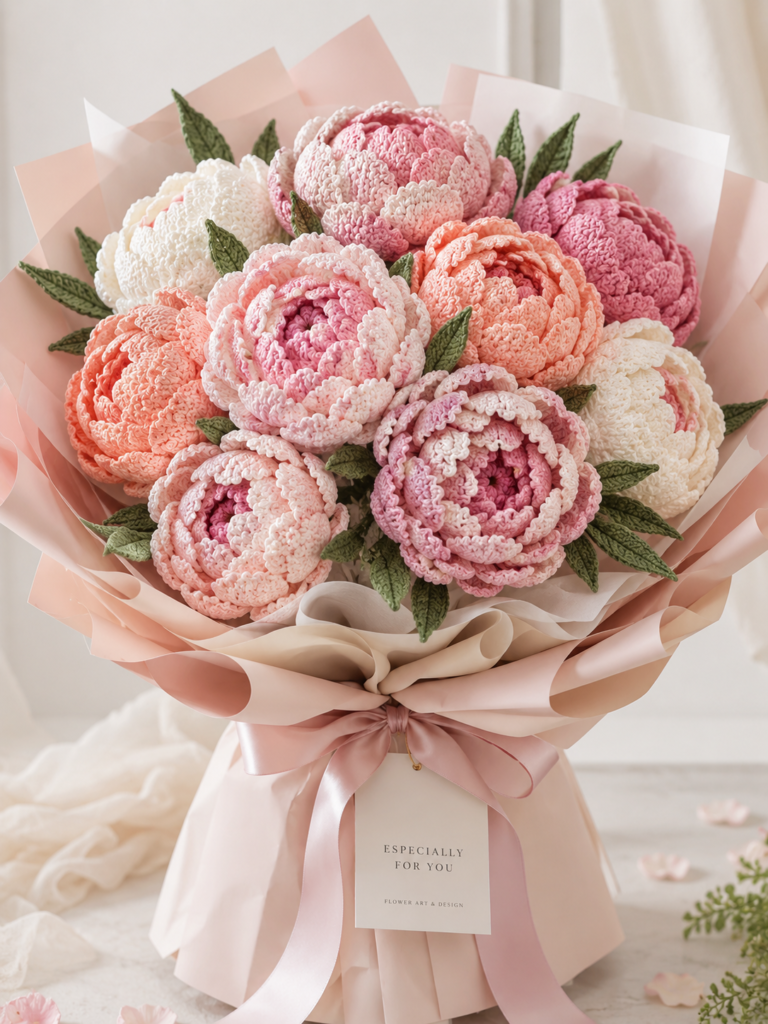
Best For: Wedding bouquets, luxury arrangements, focal flowers.
Best Yarn
- Mercerized Cotton
- Fine Cotton Yarn
- Premium Cotton Blend
Materials
- 2.5mm Crochet Hook
- Pink, Cream, Coral Yarn
- Green Yarn
- Floral Wire
- Floral Tape
- Yarn Needle
- Scissors
- Bouquet Paper
- Ribbon
Detailed Bouquet Tutorial
Step 1: Crochet 7–10 large peony flowers.
Step 2: Shape and layer petals carefully.
Step 3: Create large peony leaves.
Step 4: Attach strong wired stems.
Step 5: Arrange the largest blooms in the center.
Step 6: Add smaller blooms around them.
Step 7: Insert greenery between flowers.
Step 8: Check the balance from all sides.
Step 9: Secure stems tightly.
Step 10: Wrap with elegant bouquet paper.
Arrangement Tips
Keep the bouquet rounded.
Use odd numbers of blooms.
Mix blush and cream shades.
Let flowers remain slightly open.
Add eucalyptus leaves.
8. Crochet Carnation
Skill Level: Intermediate | Hook: 3mm | Yarn: DK cotton | Time: ~40 minutes
Crochet carnations are worked using a long strip of ruffled stitches that is then coiled and secured at the base, the same basic technique used to make real carnations from ribbon. The result is a dense, full bloom with that distinctive fringed edge. They look beautiful in red, white, or soft pink.
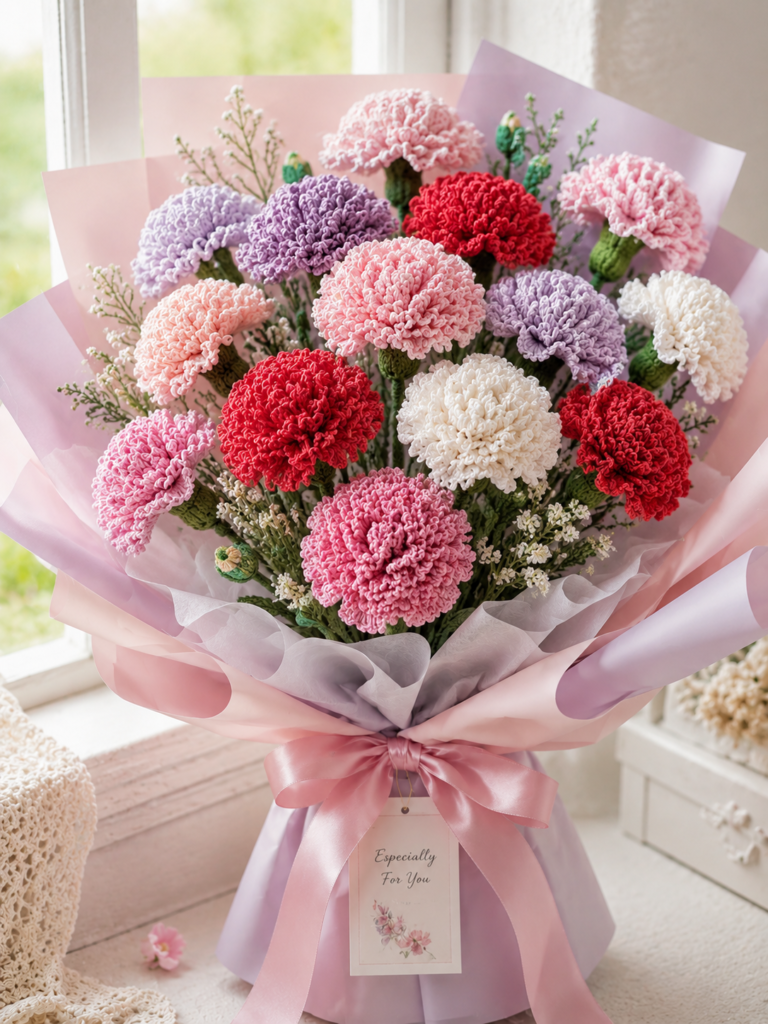
Best For: Secondary flowers, formal bouquets, mixed arrangements.
Best Yarn
- Mercerized Cotton
- DK Cotton Yarn
- Cotton Blend
Materials
- 3mm Crochet Hook
- Colored Yarn
- Green Yarn
- Floral Wire
- Floral Tape
- Yarn Needle
- Scissors
- Ribbon
- Wrapping Paper
Detailed Bouquet Tutorial
Step 1: Crochet 10–15 carnations.
Step 2: Create ruffled petal edges.
Step 3: Make matching leaves.
Step 4: Attach wired stems.
Step 5: Arrange flowers in a dome shape.
Step 6: Add greenery between blooms.
Step 7: Vary flower heights.
Step 8: Fill empty spaces.
Step 9: Secure stems.
Step 10: Wrap and finish.
Arrangement Tips
Avoid perfectly even spacing.
Mix several carnation shades.
Add baby’s breath.
Keep the arrangement soft and rounded.
Include leafy greenery.
9. Crochet Cherry Blossom Sprig
Skill Level: Beginner | Hook: 3mm | Yarn: DK cotton, pale pink | Time: ~30 minutes
Cherry blossom sprigs add a delicate, Japanese-inspired aesthetic to any arrangement. Tiny 5-petal flowers are attached along a thin green stem, mimicking the look of real cherry blossom branches. These work beautifully in neutral or pink bouquets.
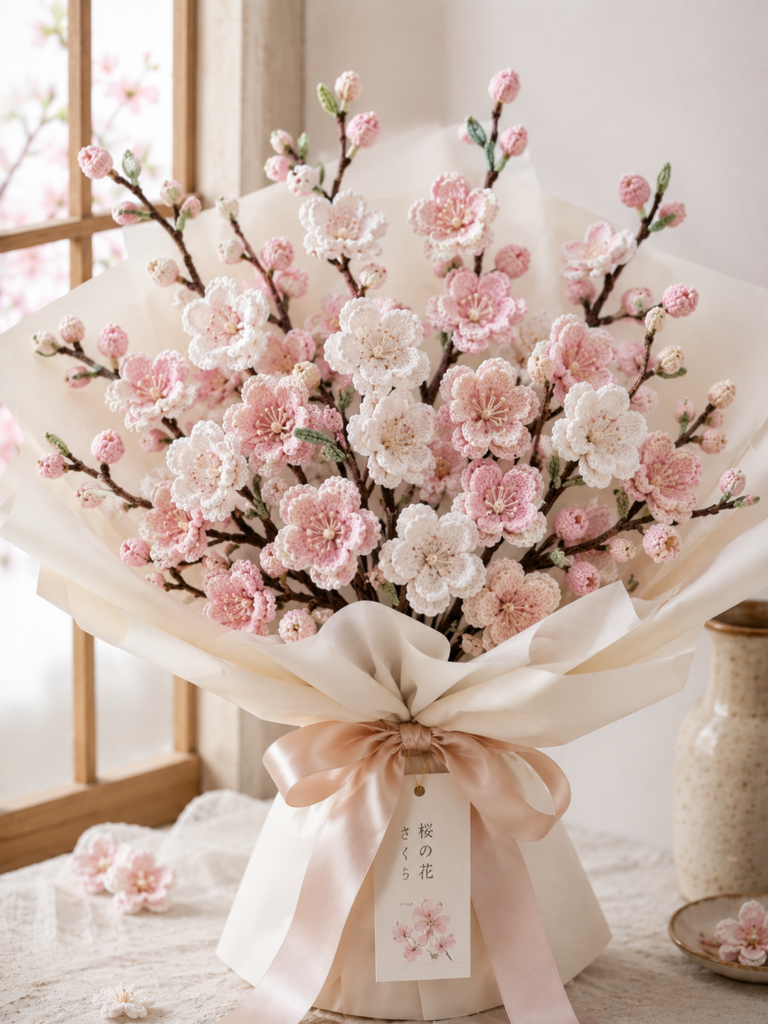
Best For: Spring arrangements, delicate bouquets, Asian-inspired designs.
Best Yarn
- Fine Cotton Yarn
- Crochet Thread
- Mercerized Cotton
Materials
- 2mm–2.5mm Crochet Hook
- Pink Yarn
- White Yarn
- Brown Floral Wire
- Floral Tape
- Yarn Needle
- Scissors
Detailed Bouquet Tutorial
Step 1: Crochet 40–60 tiny blossoms.
Step 2: Prepare branch-like wire stems.
Step 3: Attach blossoms along branches.
Step 4: Create multiple flowering sprigs.
Step 5: Bundle branches together.
Step 6: Adjust branch angles.
Step 7: Keep the bouquet open and airy.
Step 8: Secure stems.
Step 9: Wrap lightly.
Step 10: Finish with ribbon.
Arrangement Tips
Focus on natural movement.
Leave plenty of open space.
Use pale colors.
Vary branch lengths.
Avoid dense arrangements.
10. Crochet Lily
Skill Level: Intermediate | Hook: 3.5mm | Yarn: DK cotton | Time: ~50 minutes
Crochet lilies feature long, tapering petals worked flat, then curved by blocking or strategic shaping. Add contrast-colored stamens using thin yarn or embroidery floss for a lifelike effect. Lilies are excellent focal or secondary flowers in elegant, wedding-style arrangements.
Best For: Focal/secondary flowers, wedding bouquets, elegant arrangements.
Best Yarn
- Fine Cotton Yarn
- Crochet Thread
- Mercerized Cotton
Materials
- 2mm–2.5mm Crochet Hook
- Pink Yarn
- White Yarn
- Brown Floral Wire
- Floral Tape
- Yarn Needle
- Scissors
Detailed Bouquet Tutorial
Step 1: Crochet 40–60 tiny blossoms.
Step 2: Prepare branch-like wire stems.
Step 3: Attach blossoms along branches.
Step 4: Create multiple flowering sprigs.
Step 5: Bundle branches together.
Step 6: Adjust branch angles.
Step 7: Keep the bouquet open and airy.
Step 8: Secure stems.
Step 9: Wrap lightly.
Step 10: Finish with ribbon.
Arrangement Tips
Focus on natural movement.
Leave plenty of open space.
Use pale colors.
Vary branch lengths.
Avoid dense arrangements.
Frequently Asked Questions About Crochet Flower Bouquets
How many flowers do I need for a crochet bouquet?
A small gift bouquet needs 5–7 flowers. A medium bouquet for Mother’s Day or birthdays typically uses 8–15. A full wedding bouquet contains 16–25 flowers or more. Always add 4–8 greenery pieces regardless of bouquet size; greenery makes every arrangement look fuller and more professional.
What is the best yarn for crochet flowers?
Mercerized cotton yarn gives the crispest petal definition and the most realistic appearance. For beginners working on a tighter budget, worsted-weight acrylic is widely available and easy to work with. If you want the best of both, try a cotton-acrylic blend like Lion Brand Comfortblend.
What hook size should I use for crochet flowers?
Most crochet flower patterns use a hook between 2.5mm and 4mm. As a general rule, use a hook one size smaller than your yarn label recommends. This creates tighter, more structured stitches that hold their petal shape better.
How long does it take to crochet a flower bouquet?
A single simple flower takes 15–30 minutes. A layered rose or 3D tulip takes 35–60 minutes. A complete bouquet of 12–15 flowers with stems and greenery typically takes 8–15 hours, spread over several sessions. Many crocheters work on bouquets over one to two weekends.
How do you make stems for crochet flowers?
The most realistic method: push an 18-gauge floral wire through the base of the finished flower, bend a small hook at the top to prevent pull-through, and wrap the wire from top to bottom with green floral tape (stretch it slightly as you wrap to activate the adhesive). For a more polished look, crochet a thin green tube and thread the wire through it.
Can beginners make a crochet flower bouquet?
Absolutely. Start with simple 5-petal flowers, daisies, or buttercups; all require only chain stitch and single crochet. Once you’re comfortable, progress to tulips or layered roses. A beginner can make a full, beautiful small bouquet in a weekend with just three or four basic flower patterns.
Are crochet bouquets good for weddings?
Yes, crochet wedding bouquets are increasingly popular for several reasons. They’re completely allergy-free, they last forever as a keepsake, they can be made in any color to match the wedding palette precisely, and they can be completed months ahead with no time pressure. Many brides keep their crochet wedding bouquet displayed at home for years.
How do you wrap a crochet flower bouquet for gifting?
Gather all stems together and secure the base with a rubber band. Cut a large square of kraft paper or Korean wrapping paper at a 45-degree diagonal, place the bouquet face down in the center, fold the bottom corner up over the stems, then fold in the left and right corners. Secure with clear tape and tie the whole wrap with a wide satin ribbon or twine. Add a handwritten gift tag for a personal touch.
How do you store a crochet flower bouquet?
Keep your bouquet out of direct sunlight to prevent yarn fading. For display, stand it upright in a vase or wrap the stems in a rubber band and lean it against a wall. For storage, wrap loosely in tissue paper and place in a box to prevent crushing. Avoid humid areas; moisture can distort cotton yarn over time.
How much does it cost to make a crochet flower bouquet?
A small bouquet using acrylic yarn typically costs $5–$15 in materials. A medium cotton yarn bouquet runs $15–$35. High-end cotton or specialty yarn bouquets for weddings can cost $40–$80 in materials but are still far less expensive than fresh or silk floral alternatives of the same quality.
Final Tips for Stunning Crochet Bouquets
Block your flowers. Wet blocking cotton flowers before assembling opens up petals, evens out stitches, and creates a much more polished, realistic finish. Pin petals to a foam mat in the desired shape and let them dry completely.
Use the right tension. Tight tension = firm, structured petals. Loose tension = soft, droopy petals. Aim for firm tension throughout, especially on focal flowers.
Make more than you need. Always crochet 20% more flowers than your bouquet requires. Having extras lets you replace any pieces that don’t turn out perfectly and gives you flexibility when arranging.
Photograph before gifting. A crochet bouquet this beautiful deserves documentation. Natural window light and a simple white or linen background make for stunning photos that are perfect for Pinterest and Instagram.